Design and Construction of a 3D-Printed CNC Machine
I designed and built a compact CNC machine in which many of the structural and mechanical components were manufactured using my 3D printer. The project combines additive manufacturing, precision motion, electronics and computer-controlled machining within a small desktop platform.
My primary motivation was PCB fabrication. After designing and producing electronic circuit boards, I needed a repeatable method for accurately drilling component holes and other features. The CNC machine provides automated positioning of the cutting tool, making PCB drilling considerably more precise and repeatable than manual drilling.
Although PCB drilling is its main application, the machine was designed as a general-purpose CNC platform. By changing the cutting tool and machining parameters, it can also be used for light milling, engraving, carving and machining of materials such as wood and other relatively soft materials.
Combining Additive and Subtractive Manufacturing
An interesting aspect of the project is the combination of two digital-manufacturing approaches. The CNC machine itself contains components produced by additive manufacturing, while the completed machine is used for subtractive manufacturing.
3D printing made it possible to rapidly manufacture custom motor mounts, brackets, housings and structural components and to modify them as the CNC design evolved. This created an efficient design–build–test cycle during development of the machine.
- Compact desktop CNC-machine design
- 3D-printed structural components
- Custom mechanical parts and motor mounts
- Three-axis computer-controlled motion
- Stepper-motor-based positioning
- Linear-motion mechanisms
- Spindle motor integration
- Tool and spindle mounting
- PCB drilling
- Accurate component-hole positioning
- PCB prototyping
- Light milling
- Engraving
- Wood carving
- Workpiece positioning and clamping
- Machine calibration
- Toolpath-driven machining
- Iterative mechanical improvement
PCB Drilling
The machine is used primarily to support my electronics projects. PCB layouts often require many accurately positioned holes for through-hole components, connectors and mounting points. Performing these operations manually becomes difficult when hole diameters are small and positional accuracy is important.
With the CNC machine, the drilling coordinates can be generated from the digital board design and translated into controlled machine movement. The spindle is positioned automatically over each required location, providing a repeatable workflow from electronic design to physical PCB fabrication.
Spindle and Cutting System
A spindle motor provides the rotational motion required for drilling, engraving and light machining. The spindle is mounted to the moving axis through a rigid holder designed to maintain alignment between the cutting tool and the machine coordinate system.
Tool selection depends on the application. Small drill bits can be used for PCB fabrication, while suitable engraving or cutting tools allow the same platform to perform other light CNC operations.
General-Purpose CNC Capability
The machine was intentionally designed so that it is not restricted to PCB drilling. Its three-axis architecture allows it to follow general machining toolpaths, making it useful as a small experimental CNC platform for carving, engraving and manufacturing custom parts from appropriate materials.
This flexibility also makes the machine useful as a learning platform. Different tools, feed rates, spindle speeds, workholding approaches and machining strategies can be tested while observing their effect on dimensional accuracy and surface quality.
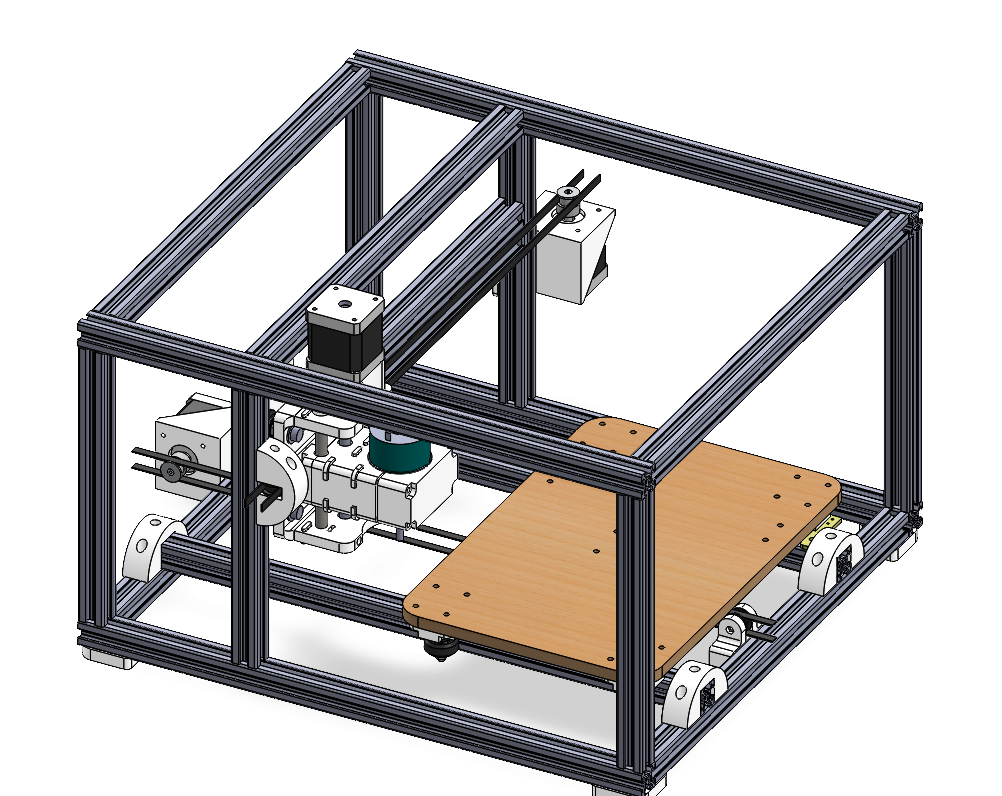
Compact CNC machine built using 3D-printed mechanical components and a spindle motor for PCB drilling, engraving and light machining.
CNC Machine Demonstration
Demonstration of the compact CNC machine in operation.