My research in geothermal and geomechanical modelling combines heat transfer, groundwater flow, porous-media processes and soil mechanics within advanced numerical frameworks. My work spans fundamental model development, numerical-method design, coupled multiphysics simulation and application to shallow geothermal systems and subsurface thermal-energy storage.
My geothermal research includes the development of three-dimensional transient models for heat transfer in the ground and around borehole heat exchangers, accounting for thermal interaction between the working fluid, borehole system, surrounding soil and groundwater. This work combines physical process understanding with finite-volume discretization, hierarchical Cartesian grids, multigrid solution techniques, verification, validation and grid-convergence analysis.
My more recent work extends geothermal modelling into coupled geomechanics. I have developed and implemented thermal capabilities for finite-element geomechanical modelling, including transient thermal elements, thermal constitutive formulations, heat-flux and environmental boundary conditions, and coupling between temperature, groundwater pressure and mechanical deformation.
A central theme of this work is the interaction between thermal, hydraulic and mechanical processes. Rather than considering heat transfer independently, I develop computational approaches in which temperature, groundwater and deformation can be treated as interacting components of the subsurface system. This provides a basis for modelling applications such as borehole heat exchangers, geothermal systems and high-capacity subsurface heat storage.
Research Development and Added Value
A distinctive aspect of my work is the continuity between fundamental
geothermal research and the development of practical multiphysics
modelling capabilities. My earlier research established a numerical
foundation for three-dimensional shallow geothermal simulation,
including detailed verification and validation. I have subsequently
extended this experience towards coupled geothermal and geomechanical
applications.
An important focus is moving beyond isolated thermal calculations
towards models in which thermal loading interacts with groundwater
conditions and the mechanical response of the subsurface. This is
particularly relevant for geothermal energy and subsurface heat-storage
applications, where changes in temperature can interact with pore
pressure, deformation and soil behaviour.
My contribution combines physical process understanding,
numerical-method development and implementation in research software.
This enables me to work across the complete development cycle: from
identifying the relevant coupled processes and formulating the model,
to implementing new computational capabilities, developing benchmark
tests and applying the resulting methods to engineering-scale problems.
Areas of Expertise
Shallow Geothermal Systems
This work includes the physical and numerical modelling of heat transfer in shallow geothermal systems, with particular attention to the thermal interaction between borehole heat exchangers, circulating working fluids, groundwater and the surrounding geological formation.
Shallow geothermal energy systems
Borehole heat exchangers
Transient heat transfer in the subsurface
Heat conduction in soil
Groundwater effects on geothermal performance
Thermal interaction between boreholes and surrounding ground
Heat transfer between working fluid and geological formations
Three-dimensional geothermal modelling
Model verification and validation
A key aspect of my work is treating geothermal systems as coupled subsurface heat-transfer problems rather than considering the borehole in isolation. This provides a physically based framework for analysing the transient thermal response of the complete borehole–groundwater–ground system and for assessing the numerical accuracy and efficiency of geothermal simulations.
Coupled Thermal–Hydraulic–Mechanical Modelling
My work includes the development of coupled geomechanical models in which heat transfer, groundwater pressure and mechanical deformation interact within the same numerical framework. This coupling is important for geothermal and subsurface energy-storage applications, where thermal loading can influence pore pressure, deformation and the overall response of the geological medium.
Thermal–hydraulic–mechanical (THM) coupling
Coupled temperature, pore-pressure and deformation modelling
Transient heat transfer in porous media
Groundwater and thermal interaction
Thermal constitutive formulations
Transient thermal finite elements
Heat-flux boundary conditions
Environmental and microclimate boundary conditions
Partially saturated porous materials
Thermal dispersion
Subsurface thermal-energy storage
A particular strength of this work is the integration of processes that are often considered separately. By coupling thermal, hydraulic and mechanical behaviour, the model can represent how temperature changes propagate through the subsurface and interact with groundwater conditions and mechanical deformation. This provides a more physically complete framework for analysing geothermal systems and subsurface heat-storage applications.
Coupled Thermal, Hydraulic and Mechanical Processes
Geothermal and geomechanical systems are governed by strongly interacting physical processes. Heat transfer changes the thermal state of the subsurface, groundwater transports heat and influences pore pressure, and variations in temperature and pore pressure can modify stresses, strains and deformation of the geological medium. These interactions make coupled thermal–hydraulic–mechanical modelling essential for many subsurface-energy applications.
Thermal energy is introduced into or extracted from the subsurface through geothermal systems, borehole heat exchangers or underground thermal-energy storage.
Heat is transported through soil and rock by conduction and, where groundwater flow is present, by advective heat transport.
Temperature changes interact with groundwater conditions and can influence the hydraulic and thermal behaviour of the porous medium.
Changes in temperature and pore-water pressure can influence stresses, strains and deformation within the geological formation.
The coupled thermal, hydraulic and mechanical response is solved numerically to evaluate the behaviour and performance of the subsurface system.
My work addresses these processes at different levels of complexity, from detailed three-dimensional heat-transfer modelling of shallow geothermal systems to coupled thermal–hydraulic–mechanical simulations. The numerical framework brings together geothermal physics, groundwater processes, porous-media heat transfer and geomechanics within a common computational approach.
Three-Dimensional Subsurface Heat Storage and Recovery
I developed a three-dimensional numerical application for subsurface
thermal-energy storage using the thermal modelling capabilities
implemented in Kratos. The objective was to simulate the complete cycle
of heat injection, subsurface storage, groundwater-driven thermal
transport and subsequent heat recovery.
The model contains two wells operating at different stages of the
storage cycle. During the first three months, hot water is injected
through the first well, creating and progressively expanding a thermal
plume within the subsurface. During the following three months, the
second well extracts water and recovers part of the stored thermal
energy.
A hydraulic-head difference is imposed across the domain, generating
groundwater flow through the geological formation. Heat transport is
therefore governed not only by thermal conduction but also by the
movement of groundwater, making the location and evolution of the
thermal plume an inherently coupled thermal–hydraulic problem.
From Thermal Implementation to a 3D Application
An important aspect of this project is that it builds directly on
the thermal functionality I implemented for the Kratos
GeoMechanicsApplication. The application provides a demanding
three-dimensional demonstration of the numerical framework under
transient geothermal conditions.
The model combines transient heat transfer, groundwater flow,
thermal properties of porous materials, heat injection and
extraction, and three-dimensional spatial transport within a
single computational framework.
Three-dimensional geothermal modelling
Subsurface thermal-energy storage
Transient heat-transfer simulation
Hot-water injection
Heat recovery through a second well
Three-month injection period
Three-month extraction period
Groundwater-driven heat transport
Hydraulic-head gradient across the domain
Thermal conduction through the geological formation
Advective heat transport by groundwater
Development and migration of the thermal plume
Temperature evolution in three dimensions
Porous-media thermal properties
Finite-element modelling
Kratos GeoMechanicsApplication
Transient thermal elements
Thermal boundary conditions
Heat-Injection Phase
During the first three months of the simulated cycle, the injection
well supplies hot water to the subsurface. Heat is transferred to the
surrounding geological medium while groundwater flow redistributes
thermal energy through the domain.
The resulting temperature field forms a three-dimensional thermal
plume whose development is determined by the combined effects of
injection, heat conduction and groundwater advection.
Heat-Recovery Phase
After the storage period, the operating condition changes and the
second well extracts water during the following three months. The
simulation therefore follows the thermal system through both charging
and recovery rather than considering a steady thermal condition.
This provides insight into how the stored heat is spatially
redistributed and how the groundwater-flow direction influences the
thermal energy available around the recovery well.
Groundwater Influence
The imposed hydraulic-head difference creates a persistent groundwater
flow across the computational domain. This is important because the
thermal plume does not remain symmetric around the injection location:
groundwater transports heat in the prevailing flow direction.
The model therefore demonstrates why realistic subsurface heat-storage
calculations need to consider the interaction between the thermal field
and groundwater movement rather than representing heat transfer by
conduction alone.
Hot-water injection → Thermal-plume development →
Groundwater-driven heat transport → Subsurface heat storage →
Water extraction → Thermal-energy recovery
Simulation
Three-dimensional simulation of the heat-storage cycle. Hot water
is injected through the first well during the charging phase and
subsequently extracted through the second well, while the imposed
hydraulic gradient transports the thermal plume through the
subsurface.
02 · Shallow Geothermal Systems
Efficient Three-Dimensional Modelling of Shallow Geothermal Systems
I developed an efficient three-dimensional numerical model for
shallow geothermal systems, with particular focus on ground-source
heat pumps and borehole heat exchangers. The model was designed to
simulate transient heat transfer between the circulating fluid,
borehole heat exchangers and the surrounding geological formation
while maintaining computational efficiency for large systems.
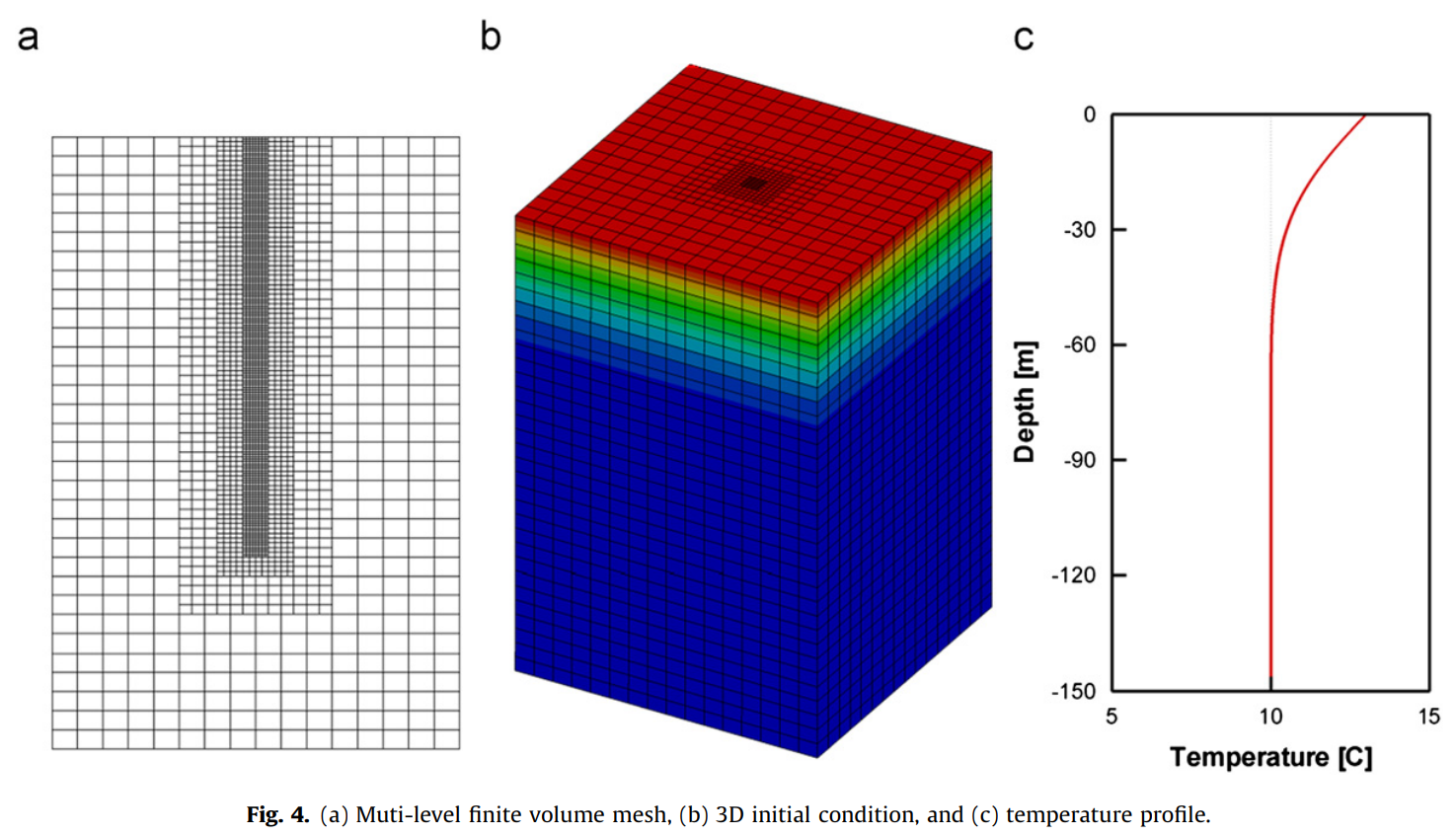
The physical system is decomposed into two interacting computational
domains: the surrounding soil mass and one or more borehole heat
exchangers. A specialized pseudo-three-dimensional representation
is used for the boreholes, while heat transfer in the surrounding
geological formation is solved using a three-dimensional Finite
Volume Method.
Computationally Efficient Multi-Scale Formulation
A key challenge in shallow geothermal modelling is the large
difference between the characteristic dimensions of a borehole
and the surrounding geological domain. Resolving both scales
directly with a uniformly fine three-dimensional mesh would lead
to very large computational systems.
The developed model addresses this scale difference using a
combination of a pseudo-three-dimensional line representation
for the borehole heat exchanger, locally refined Cartesian grids
for the surrounding soil, and a hierarchical multigrid solution
method.
This formulation concentrates computational resolution where it
is required while retaining coarser resolution farther from the
boreholes, substantially reducing the computational effort needed
for three-dimensional geothermal simulations.
Three-dimensional shallow geothermal modelling
Ground-source heat-pump systems
Borehole heat exchangers (BHE)
Transient subsurface heat transfer
Heat and fluid-flow modelling
Multiple borehole heat exchangers
Multi-layer geological formations
Pseudo-three-dimensional borehole representation
Finite Volume Method (FVM)
Locally refined Cartesian grids
Hierarchical grid structures
Multigrid iterative solution
Large three-dimensional computational domains
Model verification
Experimental validation
Grid-convergence analysis
Computational-performance assessment
Borehole Heat-Exchanger Representation
The borehole heat exchanger is represented using a
pseudo-three-dimensional line formulation rather than explicitly
discretizing every individual borehole component in three dimensions.
Thermal interactions between the components of the borehole system
are incorporated within the governing formulation.
This significantly reduces the geometrical and computational
complexity of the borehole representation while preserving its
thermal interaction with the surrounding soil mass.
Locally Refined Cartesian Grid
Heat transfer in the surrounding geological formation is solved on
a locally refined Cartesian grid. Fine computational resolution is
concentrated close to the borehole heat exchangers, where thermal
gradients are strongest, while progressively coarser resolution can
be used farther away.
This multilevel spatial representation avoids the computational cost
associated with using a uniformly fine mesh throughout the complete
geological domain.
Hierarchical Multigrid Solution
The locally refined grid is combined with a hierarchical multigrid
iterative solver. The multilevel structure accelerates the solution
of the governing equations by treating numerical errors at the
spatial scales where they can be removed most efficiently.
The combination of local refinement and multigrid enables large
geothermal problems to be solved using substantially fewer
computational volumes than would be required by a uniformly refined
three-dimensional model.
The model was systematically evaluated through verification,
validation and grid-convergence studies. Verification included
comparison against an analytical benchmark solution, while
validation included comparison between computed and measured
results.
Grid-convergence studies were used to evaluate numerical accuracy
and demonstrate the computational capability of the locally refined
formulation. This provided a quantitative basis for balancing
numerical resolution, accuracy and computational efficiency.
Three-dimensional shallow geothermal model combining borehole
heat-exchanger representations with locally refined Cartesian
grids in the surrounding geological formation.
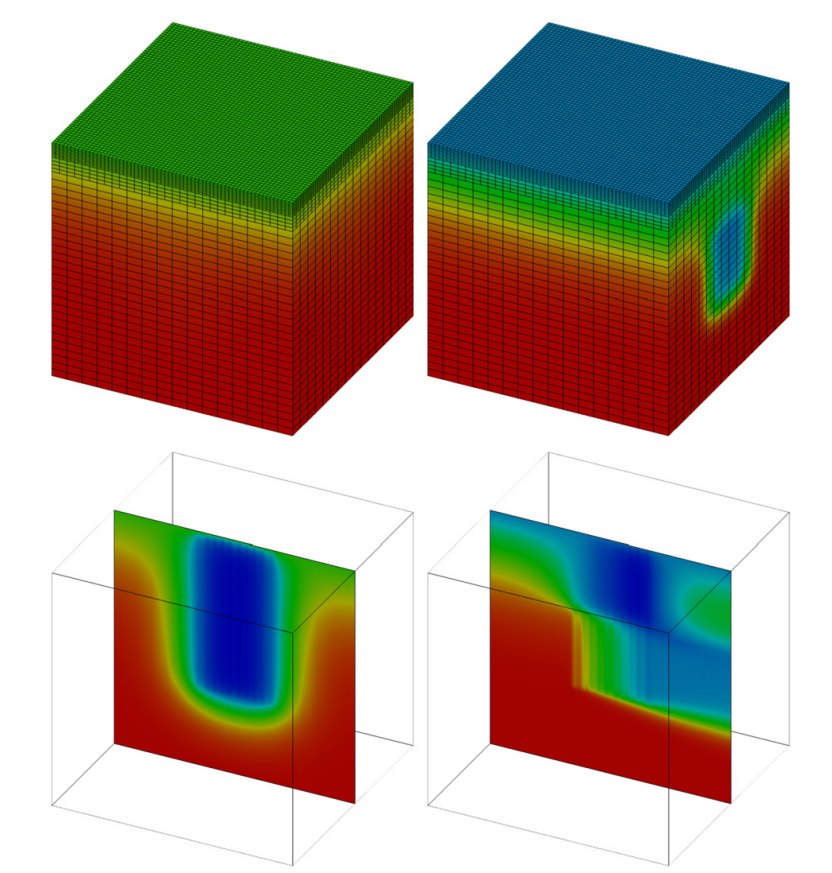
Soil temperature distribution. Upper: general view, left: without ground water flow, right: with ground water flow. Lower: cross section around the borehole heat exchangers, left: without ground water flow, right: with ground water flow
Publications
The development resulted in the peer-reviewed publication:
“An efficient finite volume model for shallow geothermal systems. Part I: Model formulation”, published in
Computers & Geosciences,
Volume 49, pages 290–296, in 2012.
The numerical evaluation was presented in the companion
peer-reviewed paper:
“An efficient finite volume model for shallow geothermal systems. Part II: Verification, validation and grid convergence”, published in
Computers & Geosciences,
Volume 49, pages 297–307, in 2012.
From Fundamental Processes to Applied Geothermal Modelling
My work connects the fundamental physics of subsurface heat transfer
with numerical methods and engineering-scale geothermal applications.
At the detailed level, the models resolve heat conduction, groundwater-
driven heat transport, borehole–ground interaction and, where required,
coupling between thermal, hydraulic and mechanical processes.
An important objective is to translate this physical understanding
into computational models that are sufficiently accurate, robust and
efficient for practical geothermal and subsurface-energy applications.
Particular attention is therefore given not only to the physical
formulation, but also to numerical efficiency, verification,
validation and computational scalability.
The broader value of this modelling approach lies in:
Understanding the interaction between heat transfer, groundwater flow and geological materials
Quantifying conductive and advective subsurface heat transport
Modelling borehole heat exchangers and their thermal interaction with the surrounding ground
Developing efficient finite-volume and finite-element formulations
Using local grid refinement and multigrid techniques for computational efficiency
Verifying numerical formulations against analytical and benchmark solutions
Validating model predictions against measured data
Performing grid-convergence and numerical-accuracy studies
Extending detailed numerical developments towards three-dimensional geothermal and heat-storage applications
Subsurface physics → Thermal and hydraulic processes →
Numerical formulation → Verification and validation →
Efficient 3D simulation → Geothermal and heat-storage applications
Overall Geothermal and Geomechanics Expertise
My expertise spans the complete modelling chain for geothermal,
subsurface heat-transfer and coupled geomechanical systems, from
understanding the governing physical processes to developing numerical
methods, implementing computational models and applying them to
three-dimensional engineering problems.
This combination enables me to investigate geothermal and subsurface-energy systems from detailed heat-transfer processes around borehole heat exchangers to fully three-dimensional coupled thermal–hydraulic–mechanical applications.
A common thread throughout my work is the integration of
physical process understanding, numerical-method development and scientific software implementation.
My experience includes developing efficient finite-volume models
for shallow geothermal systems as well as implementing thermal
capabilities within a finite-element geomechanical framework.
This provides a consistent research perspective across
geothermal physics, groundwater, heat transfer, geomechanics and subsurface thermal-energy storage,
with particular emphasis on physically based modelling,
computational efficiency and rigorous numerical verification.